
Table of Contents
Libro: Complex Cognition: The psychology of human thought
Capítulo: 12
Título: Creativity
Autor(es): Robert J. Sternberg/Talia Ben Zeev
Editorial: Oxford University Press
Año:2001
Tema central:
Recopila el conocimiento generado al rededor de la creatividad como objeto de investigación interdisciplinar. las agrupa en 8 categorías y según estas teorías describe lo que entienden como aportes creativos.
La creatividad como objeto de estudio
Creativity is the ability to producenovel, high-quality, task-appropiate products.
Perspectivas investigadas y sus autores:
- Mystical Approaches: Cannot be investigated (matter of muses)\\

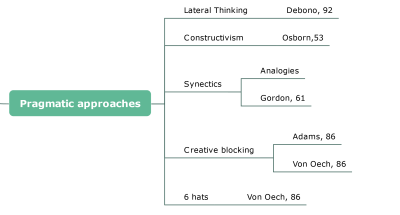
- Pragmatic Approaches: have focused on how to use creativity and how to increase it.\\
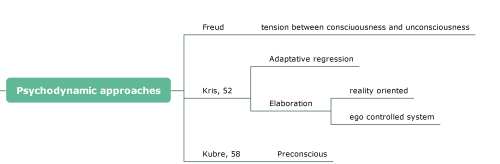
- Psychodynamic Approaches: Focuses on the unconscious processes underlying creativity.\\
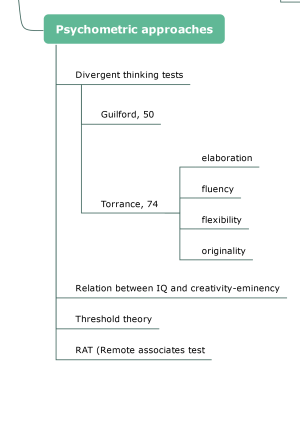
- Psychometric Approaches: How creativity can be masured\\
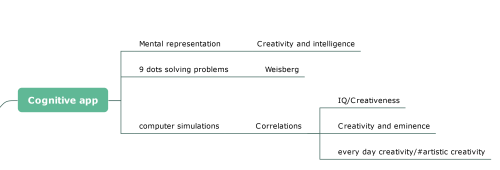
- Cognitive Approaches: Information processing and mental representations underlying creativity\\
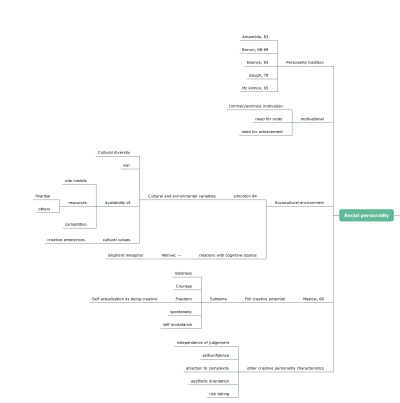
- Social-personality Approaches:Motivation, Roles of the other people, personality treats.\\
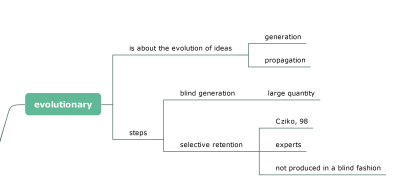
- Evolutionary Approaches:creativity is an adaptation that enhances the chances of survival\\
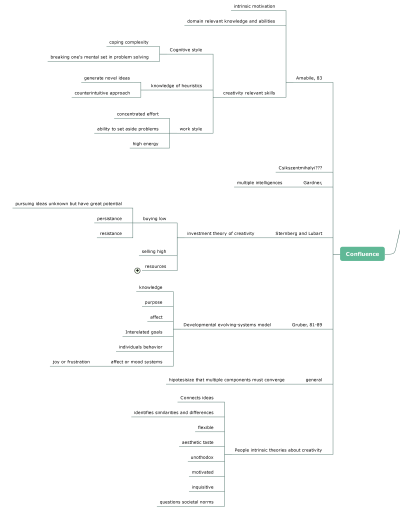
- Confluence Approaches: Integration of different theories.


Tipos de contribuciones creativas
- Normal or revolutionary (Kuhn, 1970).
- The solution to a well designed problem - the devising of an encompassed theory-frozen work-ritulized work-“high stakes” performance. (Gardner, 1993,1994.
- Parameters of psychometric models:
*(Rubenson & Runco, 1992)???
*The extent to wich they “defy the crowd” (Sternbert & Lubart, 91A, 91b, 95, 96)
- Recognition in the field (Campbell,1960;perkinson, 1995; Simonton, 1997)
- Primary and secondary creativity (Maslow, 1968)
- (Ward et al. 1999):
*Roles of focusing ( Ward et al. 1999) (Bowers, Regehr, Balthazard, & Parker, 1990;Kaplan and Symon, 1990) and exploratory thinking ( Ward et al. 1999)(bradsford & Stein, 1984; Gretzels & Csikszentmiyalyi, 1976)
*Domain specific () Universal ()
*Unestructured and structured or systematic
- Propulsion Model: (Sternberg, 1999c)
*Replication-Redefinition-Forward incrementation-Advance forward incrementation- Redirection- Reconstruction redirection-reinitiation-integration.